Final Report 20 January 2021
Update to Interim Report
David L. Elliott. Ph.D.
The Interim Report was originally scheduled to be updated and the Final Report posted after 20 January 2021.
Mortality
With respect to mortality, there was at least one more reported death of a minority person being arrested or in police custody since 24 November 2020 but information on that case is still unclear.
As of 12 January 2021, the US Centers for Disease Control reported over 370,000 deaths in the United States due to the Corona Virus pandemic. Since it may take up to eight weeks for local mortality figures to be reported to the CDC, that number will likely go up. As of 19 January 2021, the US death toll of the Corona virus was over 400,000 people!
| Estimated Cause-Specific Deaths from Covid19 in the US by Selected Race/Ethnic Categories, 2020 | ||
| Race/Ethnicity1 | Total Covid19 Deaths2 | Covid19 Deaths per 100,000 Population3 |
| 1 | 2 | 3 |
| Hispanic/Latino | 26,789 | 4.58 |
| American Indian Alaska Native, Non-Hispanic | 1,928 | 3.41 |
| Asian, Non-Hispanic | 8,546 | 3.99 |
| Black, Non-Hispanic | 32,947 | 7.22 |
| Native Hawai’ian / Other Pacific Islander, Non-Hispanic | 446 | 3.14 |
| White, Non-Hispanic | 122,460 | 5.20 |
| Multiple/Other, Non-Hispanic | 8,116 | 4.54 |
| Sources and Cautionary Note: 1. These are the race/ethnic categories selected by the CDC to report on death certificates. 2. Source: CDC https://covid.cdc.gov/covid-data-tracker/#demographics Accessed 12 January 2021. 3. Calculated by author based upon CDC column 2 this table and US Census Bureau population estimates for 2019 https://data.census.gov/cedsci/table?q=ACSDP1Y2019.DP05&tid=ACSDP5Y2019.DP05&hidePreview=true using the standard demographic formula for age specific death rates (D/P * 100,000) where D=Coronavirus deaths by race/ethnicity and P=population by race/ethnicity for 2019, the latest year available. Cautionary Note: These preliminary data must be viewed with caution. According to the CDC, Race/ethnicity was not reported on nearly one-half of the death certificates. Moreover, since race and ethnicity are social constructs, not biological, it is likely that many times race/ethnicity were coded solely because of the physical appearance of the decedent by an official who had no personal knowledge of the deceased. Census estimates are based upon race/ethnicity reported to the Census Bureau at each decennial census. |
In addition to the Cautionary Note included in the table (above) we should acknowledge that the race/ethnic categories used by the CDC do not align precisely with those used by the Census Bureau in collecting population census counts and providing intercensal estimates that I used. Despite the statistical issues, the CDC acknowledges that Blacks, Latinx/Hispanics, and American Indians were disproportionately victims of the coronavirus. See the CDC table below that uses a different methodology than I used (above) showing that all four minority groups listed have proportionately more cases resulting in death compared with whites:
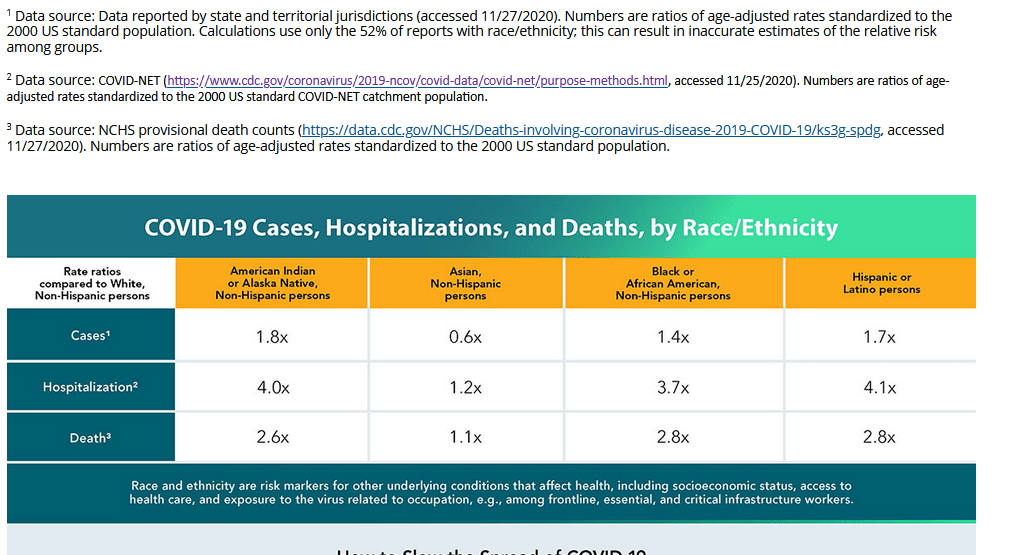
Source: https://www.cdc.gov/coronavirus/2019-ncov/covid-data/investigations-discovery/hospitalization-death-by-race-ethnicity.html accessed 19 January 2021.
Note: For example, “2.6x” means that American Indians or Alaska Native (Non-Hispanic) died of Covid19 at 2.6 times the rate of white non-Hispanic persons; keep in mind that only about half the death certificates indicated race/ethnicity.
Governance: White + Male Supremacy or Failed State?
A violent attack took place on the Nation’s Capital on 6 January 2021 while Congress was in session and verifying the winner of the presidential election, Joe Biden. At least five people died, significant damage to the Capitol building occurred, and private offices were broken into with thefts seen on video or reported. This episode contributed significantly to refining my views on governance. Briefly, our constitution was written by participants in the Philadelphia convention; they were all white men and men of means and power. Neither women nor slaves nor Indians were given the right to vote or hold public office in the Constitution that was adopted. This represents, in my view white + male supremacy at the heart of the Constitution. One might argue that 1789 was then . . . and this is 2021. An “originalist” or “textualist” on the Supreme Court believes that the Constitution should be interpreted based on the text as it was originally written. Since the original Constitution was written by wealthy and powerful white men, we can expect the original text to reflect this perspective. That is understandable. What is not understandable, in my view, is that meanings of words have changed, and society has changed in the past 230+ years; should we not interpret the Constitution as a living document?
The hooligans that broke into the Capitol that day consisted of, in part, “white supremacists” and others that opposed racial and ethnic minority rights. Secondly, this attempted coup was encouraged by then President Trump who had lost the election to Biden and who encouraged unauthorized people to prevent the awarding of the election to the winner by using threat of violence. Since Trump was supported in this endeavor by some (not most) politicians and had received millions of votes for President (but not the majority), the evidence suggests to me that the United States may be a “failing” if not a “failed” state. The next few months may tell.
Interim Report 24 November 2020
David L. Elliott, Ph.D.
Abstract
Year 2020 exploded with American racial tensions and death. Year 2020 will end 20 January 2021 with unresolved racial conflict including police homicide, pandemic with more death, and with US governance in crisis! The primary goal of this report is to discuss race and racism as they are manifested in today’s world of the Year 2020. The Covid-19 pandemic that in many respects echoes the larger environment, the American governance failures possibly including a failed state, and tyrannical authoritarian regimes across the world are all associated with the racial tensions of today. The Final Report will be issued after 20 January 2021.
* * *
Mortality 2020
All died in police custody, apprehension, or investigation by negligence or the use of deadly force in 2020; they were not the only black or Latinx people who suffered that fate in the United States. But the police homicide of George Floyd was followed by multiple, lengthy, and large Black Lives Matter demonstrations across the country by peoples of all races in opposition to police killings and other forms of violence.
Covid19 Pandemic
By the end of 2020, the coronavirus epidemic will have killed as many as a third of a million Americans, a disproportionate number of whom were members of minority groups; blacks and other racial/ethnic minorities have long experienced multiple and deadly effects of environmental racism as well as workplace hazards and homicide.
Analysis
Race and Identity
“Race” can be a slippery term. In today’s world, race is usually assumed to be an ascribed status; an individual’s identity is often defined by race or ethnicity, sometimes a self-identity or sometimes a social presumption of identity. Skin color and other observable phenotype attributes are often used to define one’s race. One’s genetic makeup or genotype is invisible. It is true that many of one’s phenotype attributes are genetically determined; however, given the vast array of observable attributes of members of the human species, including attributes that may be intentionally altered, the attribute or attributes that define the race of a population or individual are socially constructed, not genetically.
Race is thus usually associated with an individual’s observable biological characteristics (real or assumed); this is where ethnicity comes in. Ethnicity is a social construct that is usually not based upon observable characteristics; rather, it is rooted in a group’s history, geography, language, ancestry, culture, and demographics. Sometimes race and ethnicity conflate to produce a racial-ethnic identity. And some people identify with more than one race or ethnic group. Jamelle Bouie’s (2020) article “Black Like Kamala” helps to clarify this issue. Understanding the complex and changing nature of racial identity is crucial to understanding what is happening in today’s world because “race” is a complex social construct not easily determined by one’s physical appearance as is often presumed. This is made clear by Williams’ “Want a Confederate Monument? My Body is a Confederate Monument” (Williams 2020).
Race and identity are not static, but incredibly complex. The first clue is that “race” categories are not the same in all places, nor for different people and peoples (the plural is intentional) at different times. For example, the English have long considered the Irish to be a different race, and an inferior one, no less. This idea, rooted in centuries of Anglo-Celtic history and the Protestant Reformation, was brought to the North American shores with other dubious ideas from many other lands. The result is a proliferation of “races”, most of them identified differently at different times, different places, and by different people including those who may be seen as belonging to the “same” race. Even today, toxic ideas from the past have taken root in the US and have grown like weeds serving to separate people with racist, even genocidal implications. Race is slippery because it is a social construct often used to divide people up into “races”.
Racial/Ethnic Conflict
Race was an idea born in conflict in the United States. Conflict, according to some sociologists, may have a social function (Coser 1956). This includes conflict that may be racial and appear dysfunctional. The believed functions of conflict include setting group boundaries, increased cohesion of in-groups vis-à-vis out-groups, balancing the power, and other claimed functions. Balancing power? In my view, the function of some conflict may actually be to sustain a power imbalance. For example, if the function of a bank is to make a profit for its in-group, the owners and large depositors, then conflict-laden exploitation of an out-group such as redlining to increase the profits of the in-group perpetuates the imbalance of power. Let us look historically at conflict and the balance of power.
African Americans
Enslaved Africans “owned” by white people predated Columbus’s 1492 sailing in search of a route to the East. Slavery and the slave trade in Africa dates back over 1000 years and was associated with the expansion of Islam across the continent, especially across the Sahara. Portuguese traders from the mid-15th century onward prowled the west coast of Africa looking for trade profits where they discovered the existing trade in slaves, and joined that trade (Oliver 1992). Walter Rodney argues that the transatlantic slave trade initiated first by the Portuguese effectively depopulated West Africa, taking away or killing thousands of people for forced labor on the plantations of the Americas at the height of their productive years (Rodney 1972). In the words of Jamaican activist and musician Bob Marley (1984) in the song Buffalo Soldier, these people had been “stolen from Africa”. As Africa was thus underdeveloped by the transatlantic slave trade, the notion that African slaves (who were black) constituted an inferior race in North America took hold and remains well into Year 2020.
After the emancipation of slaves and the end of the Civil War, former slaves saw some significant political gains in the Reconstruction period. However, the political climate nationally was not one that supported black political participation in the former Confederate states, and change in both the Republican and Democratic Parties resulted in the withering away of the political gains made during Reconstruction. In place of Reconstruction came the KKK cross-burnings, lynchings or “Strange Fruit” in Billie Holiday’s song by that name, church bombings, discrimination against blacks in schools, at the lunch counter, or on the bus, police violence against blacks, and Jim Crow laws that targeted blacks, reducing the life chances of blacks by discrimination in housing, jobs, health care, and accumulation of wealth.
The overall long-term impact of racism has been to kill and otherwise reduce the freedom and life chances of African Americans over time—400+ years increasing the death and mortality rates of black Americans. For more information, I recommend Nikole Hannah-Jones’ (2020) extended article about the history of the oppression of black Americans advocating reparations and bringing us up to the middle of Year 2020.
American Indians
Unlike African Americans, Indian People had lived in the Americas from time immemorial, and conflict was caused by what was stolen from them–land and natural resources, as well as their lives. The First Peoples of today’s United States, Cherokee, Mohawks, Lakota, Navajo, and hundreds of other nations collectively known as “Indians” or “Native Americans,” faced genocidal conflict from the earliest European settlers on these shores and were eventually forced onto reservations where many remain today living under conditions that include poverty, poor medical care, barren land, and the lack of electricity and running water.
Additionally, while as slaves , African Americans had children and parents stolen and sold to other slave owners, many Indian children were stolen from their parents, educated in boarding schools, adopted by white families, and forcible integrated into white society. Today, we find many people of Native American descent integrated into the dominant society while their kinfolk remain ensconced on reservations lacking even the fundamental assets found in the dominant society (Johns 2020). No balance there; for whom is that conflict resulting from these actions functional? According to Jared Diamond, conflict came about as the colonial powers conquered indigenous peoples of the Americas, Africa, and Asia due to their possession of “guns, germs, and steel” in a book by that name (Diamond 1997). This gave them access to resources and labor across the earth.
Latinx Peoples
Most of the Southwest of the United States today—including Texas, New Mexico, Arizona, California, Nevada, Utah, and Colorado—was once the North of Mexico and before that Indian land, in the interim occupied by the Spaniards. It was partly purchased but mostly won by force of arms by the United States. The present-day Southwest of the United States is based upon racial ethnic identity strongly influenced by Mexican culture, itself an amalgam of Spaniard conquerors and native Indian peoples. The most striking features of this Hispanic culture is the persistence of the Spanish language and the Catholic religion, yet another source of conflict today like the English-Irish religious conflict dating to the Protestant Reformation, and before.
Mexican Americans of the Southwest are not the only Hispanics or Latinx people of the United States. The island of Puerto Rico is a colony of the United States, and its people have no vote in the Congress of the United States, but Puerto Ricans are still citizens of the US. As individuals, Puerto Ricans living outside Puerto Rico but on the US mainland have the rights of other American citizens; however, collectively on Puerto Rico, the island’s people lack rights of residents of the fifty states.
Immigrants from non-US territories in Latin America, even when they become citizens, are often faced with discrimination not unlike that faced by African Americans or Native Americans. However, many immigrants, such as Latinx immigrants who fled the Cuban Revolution or Asians seeking economic opportunities, arrived on these shores with sufficient wealth, entrepreneurial experience, and community associations that they could quickly form affluent and politically powerful cultural enclaves. In the decades preceding Year 2020, refugees from violence and lack of economic opportunities to support families in Central America (including Mexico) tried to emigrate to the United States both legally and as undocumented persons, or as families. Many were successful and this created major problems for Federal administrators with no clear political solution. By 2017, largely ineffective attempts were made to “build a wall” along the border of Mexico and the United States followed by the separation of children stolen from the parents of the would-be migrants captured by the Immigration and Migration Service. Hundreds of Latinx children are still in the United States and unable to be reunited with their families.
Asians/Pacific Islanders
The United States has seen immigration from Asia and the Pacific Islands since the mid-nineteenth century and they share many of the experience of other immigrants. But there were also some key differences. Chinese males were recruited in the 19th century to build the transcontinental railway (as were the Irish) and while fierce conditions of employment may have been similar to conditions faced by slaves, in the final analysis, the Chinese who survived the ordeal were free, unlike slaves. However, Chinese immigrants still faced hostility and conflict. In 1875, Chinese women were barred from immigrating and in 1882, the Chinese Exclusion Act was passed intended to prevent any further immigration from China. This resulted in illegal immigration: prospective Chinese male immigrants obtained fraudulent documents claiming that they were the sons of Chinese American citizens (known as paper sons) who were able to enter the country legally.
The Chinese Exclusion Act was the first federal legislation designed to stop the immigration of people based upon their nationality. Similar legislation was enacted to block Japanese immigration; nonetheless, Chinese and Japanese settled in their own enclaves and had an economic role in some cities and agricultural areas. In the early 20th century Koreans and Filipinos joined the immigrant stream from East Asia. By the time the United States entered the Second World War, many immigrant Japanese were prosperous shopkeepers. That ended following the attack on Pearl Harbor when the United States confiscated Japanese property and land on the US mainland moving Japanese families to relocation camps where they were held effectively as prisoners through the end of the Second World War–except those serving in the US military. The United States had ruled over Hawai’i since 1898; there were many Asian immigrants living and working in Hawai’i, but the Japanese in Hawai’i were not placed in relocation camps. Some former Japanese American camp residents on the mainland believed that they were “Guilty by Reason of Race” (Flamenhaft 1972) the title of a documentary film. The last two states admitted to the union, Alaska (1959) and Hawai’i (1959), both have native populations that existed long before the US took possession; neither native Hawai’ians nor Alaska natives had a say in the US gaining control of their lands: Hawai’i was annexed by the US in 1898 and Alaska was purchased from Russia in 1867.
In the post-war WWII, Vietnam, and the Middle East war eras, especially following the Hart-Celler Immigration and Nationality Act of 1965, we saw Chinese immigration from the Peoples Republic of China as well as Hong Kong and Taiwan. In addition, we saw immigration from Southeast Asia (particularly Vietnam) as well as the Middle East, Latin America, and Asia/Pacific Islands. Since 1965, the US has also seen immigration from Europe, the Indian subcontinent, the former Soviet Union, and Africa, as well. Perhaps more than any other time since the 1880s, the United States has become a nation of immigrants, but not without conflict.
Whites
What about “white” people? It depends on who you are: where you are and what historical period you live in. With respect to skin color, the range from pale to dark is so vast that there exists no scientific racial distinction within that array of skin colors. The dominant cultural group within a society makes the determination of what observable feature(s) define race, and its importance, in a word, dominants construct race. And the dominants may or may not be the numerical majority. Within the United States, there is a racial stratification close but not identical to economic and political power.
Thus, in pursuit of Manifest destiny, European immigrants and Americans of European background with the help of the American Cavalry spent the first full century of this nation’s existence, the 19th century, storming across the continent despoiling the land, consuming and destroying the flora and fauna, while killing and restricting the Indian Peoples to reservations. While slavery was technically ended two-thirds of the way through the 19th century, we know that even by Year 2020, freedom for all African Americans is still elusive. Were that not enough, the American Navy sailed into the Caribbean and across the Pacific Ocean seeking treasure missed by the pirates of past centuries and the US issued the Monroe Doctrine forbidding European powers from any further colonial efforts in the US backyard—all of Latin America. Racial conflict was thus both sign and symptom of Manifest Destiny.
Racism
The year 1968, not unlike Year 2020, was one filled with protest and conflict, especially by activists across the nation continuing the Civil Rights Movement but also activists against the so-called Vietnam War as well as by environmentalists, and activists for gender equality. It was also a year of assassinations: Martin Luther King and Robert Kennedy were shot to death in separate murders in 1968, five years after John F. Kennedy’s assassination and three years after the shooting of Malcolm X. A year earlier an important book, Black Power (Carmichael and Hamilton 1967) was published that articulated two faces of racism—individual and institutional. Its authors were two black activists Stokely Carmichael (later known as Kwame Toure) a leader in the Student Nonviolent Coordinating Committee (SNCC) and political scientist Charles V. Hamilton. They argued that even a century after the end of slavery, individual racism is overt, consisting of open acts of discrimination and violence by whites against blacks. Institutional racism, they argued is more covert and hidden; institutional racism is characterized by acts, laws, and even cultural artifacts that oppress the black community. This continued to ring true in Year 2020.
Individual Racism
Individual racism begins with prejudicial beliefs (Allport 1954) that can and do appear in any society, often first as ethnocentrism. It may end there with the believer discovering the errors of the beliefs, but not always. Sometimes the prejudice is passed along to family and community members and this may continue for generations, dying out when one’s education or life experiences do not conform to the prejudice. But sometimes, and not infrequently, the prejudice (as a belief, alone) may be realized by words or action, an act of discrimination: individual racism. Sometimes individual racism is now called “microaggressions” when words are hurtful or disrespectful, though not all manifestations of individual racism are technically “aggression”; Konrad Lorenz (1966) argued that aggression required the intent to threaten or cause harm. These aggressions are not “small” as might be inferred from “micro”. They are micro in the sense of involvement of the self and interaction with others. And they might not even be intended to cause harm; but they do. Sometimes people say foolish or ignorant things that are offensive to others and interpreted as racist or threatening; this is microaggression. When racism has become society wide as in Jim Crow laws, or is commonplace as violent acts or microaggressions that are tolerated generation after generation, racism has become an institution
Institutional Racism
All too often, racist acts are intended and are physically aggressive: from fighting or threats of violence to actual racial violence. This moves into the macro realm of institutional racism. The violent acts may be spontaneous, what we call “collective behavior”, or they be instituted by what the Southern Poverty Law Center (SPLC) today calls “hate groups.” See the SPLC Hate Map (SPLC 2019). Many of these hate groups have traditionally been identified as “white supremacist” though since this term has a gained a negative impact upon the public, alternate names adopted by white racist groups such as “white nationalist” or “Proud Boys”, possess similar ideology commonly associated with eugenics.
Eugenics is a now discredited belief in “social Darwinism”: Thomas Henry Huxley, the 19th century English biologist, was a proponent of applying Darwin’s theory of evolution not just to species but to human beings. Application of Darwin’s theory of evolution to human races was propagated first by Sir Francis Galton the 19th century English social scientist as well as British philosopher/sociologist Herbert Spencer who influenced American sociologists in the 19th and 20th centuries, as well as Hitler in the 20th century! Aubrey Clayton (Clayton 2020) has recently demonstrated the impact of Galton’s eugenics in the development of the statistical sciences, yet another influence on sociologists even today, though now statisticians are looking critically at eugenics-influenced statistics. The impact of this racist ideology within the natural and social sciences, and society overall, shows the roots of racism today. Thus, we see that prejudice (whatever the source) can morph into both individual and institutional racism.
There are at least two specific, related meanings to “institution.” First, as we commonly think of it, an institution is a concrete organization with membership that one may enter or leave and that serves some purpose, generally (not always) with some benefit to the members. If one is a college or university student, the college or university is an institution—bricks and mortar or virtual. Corporate workplaces are institutions; the military, governmental and nongovernmental organizations are institutions; religious organizations are institutions—all in the sense that they are formally organized, have a membership, a function within society, and expect to continue to exist indefinitely. With respect to racism within a formal organization, insofar that they have a discriminatory or other negative impact upon other racial groups—this is institutional racism. Given the prevalence of prejudice or biases (often not recognized as such by the holder), many organizations perpetuate institutional racism, perhaps unintentionally or because it serves the goals of the organization—even when negative implications for those impacted is revealed.
Racism may also become an institution. Racism was and still is today constituted, for example, by monuments standing for Confederate leaders and by laws and practices that have the intent and effect of reducing or eliminating the voice of blacks at the ballot box.
Racism: System or Structure?
In Year 2020 you may have seen racism sometimes referred to as “systemic” racism and sometimes as a “structure” of racism. They sound similar and one thinks of a “social system” or a “social structure.” But words have meaning, and meaning is important; in this case, especially important. Sociologically, a “system” suggests a society with multiple unique components or institutions each performing necessary functions together like organs in a body. This is one partial metaphor for society. A “structure” suggests a hierarchal or stratified social apparatus that is inherently unequal; think: class structure, power structure, etc., another partial metaphor for society. But a fuller understanding of society would acknowledge both system and structure. I argue here that American society has both systemic and structural racism and the two reinforce one another.
The systemic variant of racism, as we have seen, is rooted in prejudice as revealed in individual racism and reproduced societally through institutional racism; this takes place in the institutions that make up the system. Structural inequality has deep roots, perhaps as deep as human civilization, itself, but not necessarily as racism. The structural roots of inequality precede racism and are probably entrenched in patriarchal society and later, capitalist society. Capitalism only functions at its full potential when a small class of capitalists can mobilize production of the larger part of society for its own financial benefit. That is why a patriarchal society is well-suited as the incubator of capitalism. And when slavery in the United States was ended, as much because it was inefficient as it was abhorrent to some people, the now-freed slaves in the apparently defeated white supremist South became the group (identified by physical appearance) that could be super exploited eventually as wage earners thus increasing the wealth and power of the capitalist class, often the one-time plantation slave owners.
But reducing the problem of racism to a black-white dynamic is too simplistic. Structural racism is not binary, nor is race. Racism is part of a structure of inequality or stratification. This structure is not binary, either. It is not whites on top and everybody else on the bottom. Bear in mind that many white people have modest incomes or are poor and live where there are few opportunities for employment, not unlike many blacks. What makes it appear to be solely a black-white phenomenon is the lingering white supremist culture of the former slave states.
Ta-Nehisi Coates (2017) advocates reparations for black America and he makes his point both by referencing some canonical works of (western) civilization and by tracing through generations the experiences of black Americans attempting to achieve the American dream of home ownership. What is remarkable is the fraudulent ways that blacks of some means were deprived of what little wealth they had accumulated. This has continued well into the 21st century by racist appraisers who down-value homes believed owned by African Americans, as demonstrated by Debra Kamin in the New York Times (Kamin 2020). And this is just the latest. Should they be compensated for their losses? Absolutely. But the idea of reparations factors into the compensation non-quantifiable feelings, morality, and ethics that pre-date any person living in this world today. The concept of reparations, as venerable as it is, actually ends the discussion before it begins. If African Americans are to be compensated for their historical contribution to the United States, what about American Indians, Latinos, Alaska natives, Hawai’ian and other Pacific Island natives, and those in the Caribbean—all from lands claimed today by the US government? There must be a better way to address the valid claims of all people living today.
The Authoritarian-Redux, Pandemic Racial Violence Hypothesis:
According to the World Health Organization (WHO), a “pandemic is the worldwide spread of a new disease;” my hypothesis is that a pandemic of state-sponsored or tolerated racial violence including genocide usually thought to havestarted with the Nazi attempt to exterminate Jews (and others), though we thought it had ended with the end of World War Two, has continued in the US and other various parts of the world since that time, sometimes in more virulent forms than in others. This pandemic was marked by Hitler’s Mein Kampf, whose attempt to define superior and inferior racial groups originated in Europe in order to justify the Holocaust that was to come. However, this pandemic reaches farther back in the United States: The political founders of this nation were landed white males; many were slave owners. The democracy they founded was by and for white males; women, slaves, and poor whites were effectively excluded from participation in the nation’s governance apparatus. Were that not bad enough, a large percentage of the founders were what we know today as “white supremacists” whose ideological successors attempted to withdraw from the union to establish an independent, white supremacist state led by a slave-owing oligarchy, an action that led to civil war. The Confederate States failed, but only partially.
“Democracy” has traditionally been thought of as both a political system of representative government featuring majority rule, and of government “of the people, by the people, and for the people” as Lincoln expressed in the Gettysburg Address. Representative government and government of the people are not necessarily one and the same. One can have a political system with representation that follows established technical parliamentary rules even if it does not represent everyone. This is the system established by the original Constitution of the United States; representation was restricted to free white men. The essence of a full democracy without restrictions on eligibility to vote ordinarily excludes the possibility of authoritarian rule at the national level. In Year 2020 and earlier, I believe that we have seen an authoritarian redux, a throwback to former forms of “representative” government that have come about through systematic actions that actively prevented racial minority people from voting despite an otherwise high voter turnout in Year 2020, and parliamentary leadership that failed to follow established precedent.
As Year 2020 closed, the results of the Presidential election were challenged. Tension about the election was high. There is talk in some quarters of America being a “failed state.” Briefly, a failed state has lost legitimacy, internally and globally. It cannot keep order or provide adequate public services. It cannot protect itself from threats abroad. Most democratic states, no matter what challenges they may face, do not fail though life may be difficult. However, should democracy lapse, that alone may be an indicator of failure.
The Interim Report on Racism and the Pandemics of Year 2020 is not the place analyze the “failed state” question; that will be taken up in the Final Report after January 20, 2021.
References Cited
Allport, Gordon W. 1954. The nature of prejudice. Cambridge, Mass.,: Addison-Wesley Pub. Co.
Bouie, Jamelle. 2020. “Black Like Kamala.” in Sunday New York Times.
Carmichael, Stokely, and Charles V. Hamilton. 1967. Black power; the politics of liberation in America. New York,: Random House.
Clayton, Aibrey. 2020. “How Eugenics Shaped Statistics: Exposing the damned lies of three science pioneers.” in Nautilus.
Coates, Ta-Nehisi. 2017. We were eight years in power : an American tragedy. New York: One World.
Coser, Lewis. 1956. The Functions of Social Confict. New Yoek: The Free Press.
Diamond, Jared M. 1997. Guns, germs, and steel : the fates of human societies. New York: W.W. Norton & Co.
Flamenhaft, Fred. 1972. “Guilty by Reason of Race.”
Hannah-Jones, Nikole. 2020. “What is Owed: If true justice and equality are ever to be achieved in the United States, the country must take seriously what it owes black Americans.” New York Times:MM30ff.
Johns, Wahleah (2020). “” New York Times, May 13. . 2020. “A Life on and Off the Navajo Nation.” in New York Times.
Kamin, Debra. 2020. “Black Homeowners Face Discrimination in Appraisals.” in New York Times.
Lorenz, Konrad. 1966. On aggression. London,: Methuen.
Marley, Bob. 1984. “Buffalo Soldier.” in Legend.
Oliver, Roland Anthony. 1992. The African experience. New York, N.Y.: IconEditions.
Rodney, Walter. 1972. How Europe underdeveloped Africa. London,: Bogle-L’Ouverture Publications.
SPLC. 2019. “Hate Map 2019.”
Williams, Caroline Randall. 2020. “You Want a Confederate Monument? My Body is a Confederate Monument.” in New York Times
 Racism and the Pandemics of Year 2020